
Tech
NASA SLS Rocket Punched a Hole in Earth’s Upper Atmosphere — and Briefly Threw Off GPS

What Happened
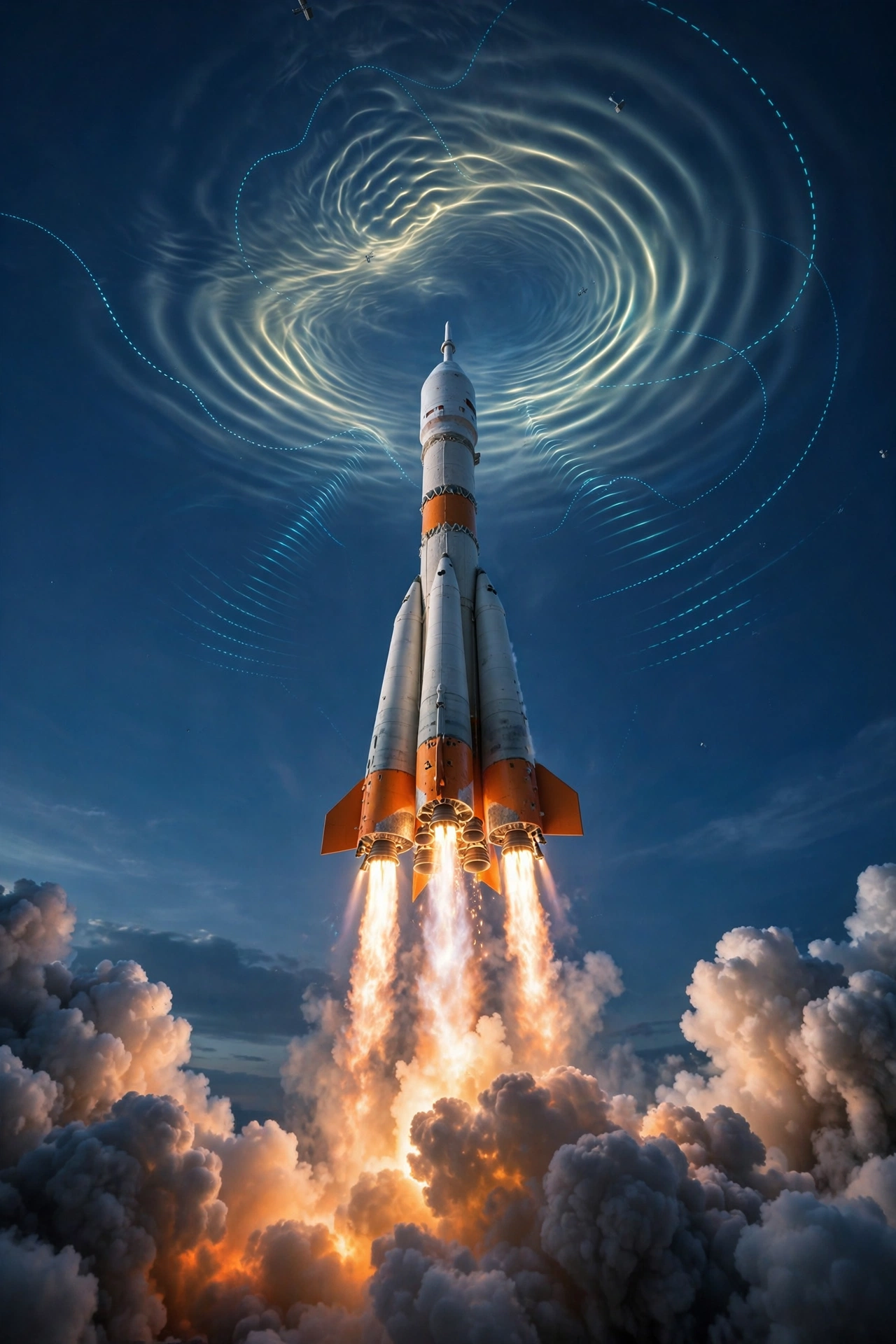
When NASA’s Artemis II mission lifted off on April 1, 2026, it did more than send four astronauts on a trip around the Moon. According to a new study, the giant Space Launch System (SLS) rocket also punched temporary holes in Earth’s upper atmosphere — disturbances so large they stretched about 3,100 miles (5,000 kilometers) across North America and were strong enough to throw off GPS readings by several meters.
Before you picture a hole in the sky, it helps to know what scientists actually mean. The “hole” is not a gap you could see or fly through. It is a patch of the ionosphere — the electrically charged layer of the upper atmosphere, starting about 30 miles (50 kilometers) above the ground — where the number of free electrons suddenly dropped. Think of it like a dent in an invisible layer, not a tear in the sky.
How Scientists Found It
The discovery came from researchers at National Cheng Kung University in Taiwan. They did not watch the rocket itself. Instead, they studied data from networks of high-precision GPS receivers fixed to the ground across the Americas. These receivers are normally used to track the tiny movements of tectonic plates before earthquakes.
GPS works by measuring how long signals take to travel from satellites to receivers on the ground. When those signals pass through the ionosphere, changes in free electrons can speed them up or slow them down. By measuring those tiny timing shifts, the researchers could map how the Artemis II launch changed the ionosphere along the rocket’s path. The study has been published as a preprint in the journal Geophysical Research Letters.
Two Disturbances, 3,100 Miles Wide
The researchers found two separate disturbances, both stretching east to west across the American continent like giant contrails:
- The core stage trail: left behind by the SLS core stage, the 212-foot (65-meter) central part of the rocket.
- The upper-stage burns: caused by two later engine burns of the rocket’s upper stage, fired at an altitude of about 115 miles (185 kilometers) — right inside the ionosphere — more than an hour after liftoff. These burns pushed the Orion capsule free of Earth’s gravity and on its way toward the Moon.
The upper-stage burns left the stronger mark, because they happened directly inside the charged layer rather than just passing through it.
Why a Rocket Can Punch a Hole in the Sky
As a rocket races upward faster than sound, it creates a shock wave that shoves the thin, electrically charged gas of the ionosphere aside. The result is a trail of disturbed plasma — sometimes called a “plasma contrail” — along the rocket’s path.
This is not a new idea. Rocket launches have been known to disturb the ionosphere before. What makes Artemis II stand out is the size. The researchers found these disturbances were stronger than any caused by other rocket launches so far — up to ten times more intense than the ones seen after test launches of SpaceX’s Starship, even though Starship produces about twice the liftoff thrust of the SLS.
Did It Actually Break GPS?
Here is where the headlines need a careful read. No widespread GPS outage was reported. What the ground stations picked up were changes in electron levels equal to positioning errors of several meters, in a temporary and localized area.
For everyday phone navigation, an error of a few meters barely matters — your map dot might sit slightly off the road. But for high-precision uses, it matters a lot. Study co-author Charles Lin, an earth science professor at National Cheng Kung University, pointed out that an error of a couple of meters is enough to make a self-driving car change lanes, and it could also affect drone positioning and surveying work that depends on exact locations.
The good news is that the effect did not last. Rocket-launch disturbances fade much faster than the GPS problems caused by severe solar storms, which can last for days. The study describes the Artemis II disturbances as temporary, and follow-up reporting notes the trails faded within about an hour. The exact minute-by-minute recovery was not stated in the study coverage, so treat “about an hour” as an approximate figure, not a precise one.
Why Artemis II Matters Beyond the Hole
Artemis II was a historic flight in its own right. Launched from Kennedy Space Center in Florida, it carried four astronauts around the Moon and back — the first crewed trip to lunar space in more than 50 years — before splashing down on April 10, 2026. It is a stepping stone toward landing astronauts on the Moon again and building a lasting human presence there.
The ionosphere finding matters because it is a preview. As rockets get bigger and launches get more frequent, scientists want to understand how each flight disturbs the upper atmosphere — especially when GPS, aviation, and autonomous vehicles all depend on signals passing through that same layer.
What This Means for Future Launches
For most of us, nothing changes. Your phone’s GPS will keep working, and a single rocket launch is not going to knock out navigation. But for engineers planning self-driving cars, drone delivery, and precision farming, the Artemis II study is a useful warning: during and shortly after a big launch, GPS readings near the flight path can be off by a few meters.
It is also a reminder that even our most familiar technology runs through a thin, changeable layer of sky — and a rocket powerful enough to reach the Moon is powerful enough to leave a mark on it.
Frequently Asked Questions
Did NASA’s Artemis II rocket really tear a hole in the atmosphere?
Not in the literal sense. It created temporary patches in the ionosphere where free electrons were depleted. “Hole” is shorthand scientists and reporters use for that depletion, and the layer refills on its own.
Did the Artemis II launch cause a GPS outage?
No broad outage was reported. Ground stations detected changes equal to temporary, localized GPS errors of several meters — not a shutdown of GPS service.
How big was the disturbance?
Two disturbed regions stretched about 3,100 miles (5,000 kilometers) east to west across North America, with the stronger one caused by upper-stage engine burns at around 115 miles (185 kilometers) altitude.
When did Artemis II launch?
Artemis II lifted off on April 1, 2026, from Kennedy Space Center in Florida, and splashed down on April 10, 2026.
Is the ionosphere hole permanent?
No. The disturbances were temporary and faded relatively quickly, unlike solar-storm effects that can last for days.

NASA SLS Rocket Punched a Hole in Earth’s Upper Atmosphere — and Briefly Threw Off GPS

How Does Alexa Work? Explained in Simple Terms

Man on Fire Explained: Denzel Washington’s 2004 Thriller, Cast and Where to Watch Free

Empower Your SEO and Design with Seotoolsgroupbuy.us’ Designer Plan

Twstalker Twitter Web Viewer: Guide to Anonymous Twitter Browsing
