
Tech
What Is a Robot Vacuum? Explained in Simple Terms

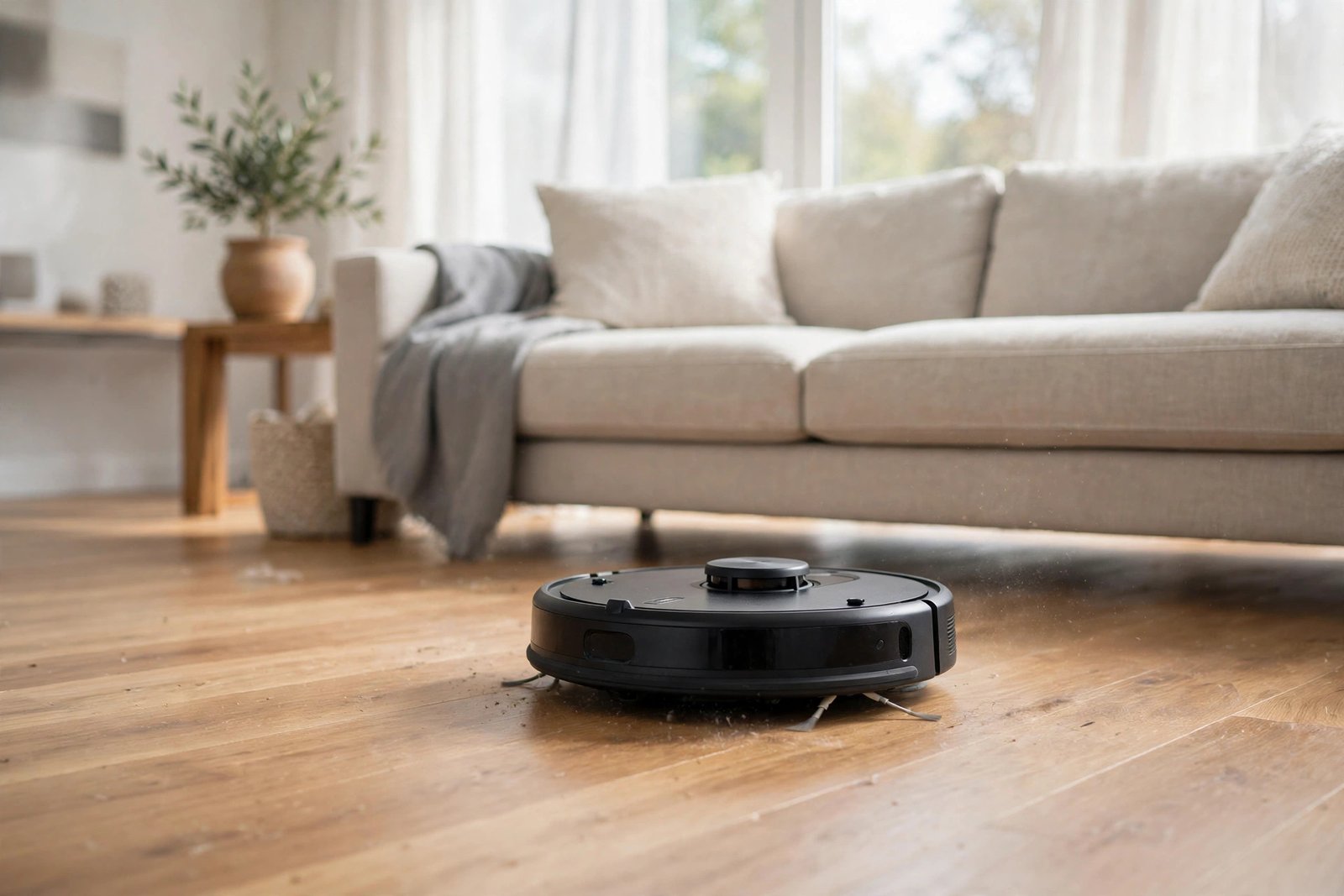
A robot vacuum is a small, flat cleaning machine that vacuums your floors all by itself. You press a button or set a schedule, and it drives around your home, picks up dust, crumbs, and pet hair, then goes back to its charging dock when it is done. You do not push it, and you do not have to be home while it works.
Think of it as a regular vacuum cleaner that learned to drive. It is round or D-shaped, low enough to slide under most sofas and beds, and it runs on a rechargeable battery. Robot vacuums have been around since the early 2000s — iRobot’s first Roomba came out in 2002 — but today’s models are much smarter, with mapping, app control, and self-emptying docks.
How Does a Robot Vacuum Work?
A robot vacuum does three jobs at once: it finds its way around, it picks up dirt, and it keeps itself charged. Here is how each part works.
It finds its way around your home
Every robot vacuum has sensors that stop it from bumping into walls, falling down stairs, or getting stuck. Cliff sensors underneath watch for drops like stair edges, and bumper sensors tell it to turn when it touches something.
Cheaper models move in a random pattern. They bounce around the room until they have covered most of it. It works, but it is slow and they can miss spots.
Better models build a map of your home. They use either a spinning laser (called LiDAR) or a camera to measure the rooms and remember the layout. With a map, the vacuum cleans in neat, straight lines, knows which rooms it has finished, and lets you tell it to clean only the kitchen, or to stay out of the kids’ room. Some high-end models can even spot and drive around things like shoes, cables, and pet bowls.
It picks up dirt and pet hair
Underneath, a robot vacuum has spinning side brushes that sweep dirt out of corners and along edges, and a main brush that lifts dirt off the floor. A small motor creates suction that pulls everything into a dustbin inside the machine. Suction power is measured in Pascals (Pa) — higher numbers mean stronger suction, and most decent models offer at least 1,500 to 2,000 Pa.
Many models also have a filter in the dustbin that traps fine dust. If allergies are a concern, look for one with a HEPA filter, which is rated to trap 99.97% of particles as small as 0.3 microns, including pollen and pet dander.
It charges itself
Robot vacuums run on rechargeable lithium-ion batteries. Most run for 60 to 180 minutes on one charge, depending on the model and the suction setting. When the battery gets low, or the cleaning is finished, the vacuum drives itself back to its charging dock. Smarter models remember where they stopped and pick up cleaning right there after recharging.
The 4 Main Types of Robot Vacuums
Not all robot vacuums are the same. Here are the four types you will see in stores:
- Basic robot vacuums — the cheapest option. They clean in a random pattern, have small dustbins, and usually no app or mapping. Good for a small apartment or a single room.
- Mapping robot vacuums — they use LiDAR or a camera to map your home, clean in straight lines, and let you set no-go zones and clean specific rooms from an app. Best for medium and large homes.
- Vacuum and mop combos — these vacuum first, then wipe hard floors with a damp pad from a small water tank. They are handy for kitchens and hard floors, but they only handle light dirt, not sticky messes.
- Self-emptying robot vacuums — when the robot docks, the base sucks the dirt out of its bin into a much bigger bag or container. You only need to empty it every few weeks — some docks hold up to 60 days of dirt. Best for pet owners and anyone who wants the least hands-on cleaning.
What Can a Robot Vacuum Clean — and What Can’t It?
Robot vacuums are great at everyday upkeep: dust, crumbs, pet hair, and light dirt on hard floors like wood, tile, and laminate, and on low-pile carpets. Run one daily and your floors stay noticeably cleaner with almost no effort.
But they have limits, and it is better to know them before you buy:
- They cannot do stairs. A robot vacuum cleans one floor at a time. Some models can store maps for several floors, but you still have to carry the machine upstairs yourself.
- They struggle with thick carpet. Deep-pile rugs and thick carpets are hard for their small motors. They clean the surface but cannot pull out dirt buried deep in the fibers the way a full-size vacuum can.
- They cannot handle big messes. Large spills, wet mud, or a knocked-over plant are jobs for a regular vacuum or a mop.
- They get stuck on clutter. Loose cables, socks, and small toys on the floor can trap them or get tangled in the brushes.
In short, a robot vacuum is a maintenance tool, not a replacement for a full-size vacuum. Most owners still do a proper deep clean with a regular vacuum once a week or so.
How Much Does a Robot Vacuum Cost?
Prices have come down a lot, and there is a model for most budgets:
- Basic models: roughly $150 to $250. Random navigation, small dustbin, no mapping. Fine for a small flat.
- Mid-range models: roughly $250 to $500. Mapping, app control, room-by-room cleaning, and often a mop. This is the sweet spot for most homes.
- Premium models: roughly $600 to $1,000 or more. Self-emptying docks, obstacle avoidance, the strongest suction, and the smartest mapping.
Remember the running costs too. Filters usually need replacing every two to three months, brushes wear out, and the battery typically needs replacing after two to three years of regular use. None of this is expensive, but it is worth knowing before you buy.
Who Should Buy a Robot Vacuum?
A robot vacuum makes the most sense if:
- You are short on time. It keeps floors tidy while you are at work or out of the house.
- You have pets. Daily runs keep pet hair under control between deep cleans, and many models have tangle-free brushes made for the job.
- You have allergies. Daily cleaning plus a HEPA filter helps keep dust and dander down.
- Most of your floors are hard floors or low-pile carpet. That is where robot vacuums do their best work.
- You like smart home gadgets. Most models work with Alexa and Google Assistant, so you can start a clean with your voice.
Who Should Skip One?
A robot vacuum may not be worth it if your home is mostly thick, deep-pile carpet, if every room is full of cables and clutter on the floor, or if you live in a small space you can vacuum by hand in five minutes. If you expect one machine to replace all vacuuming forever, you will be disappointed — it is a helper, not a full replacement.
What to Look For Before You Buy
If you decide to get one, check these things first:
- Mapping or random? For anything bigger than one or two rooms, mapping is worth paying for. Random models miss spots and waste time.
- Suction power. Look for at least 1,500 to 2,000 Pa. Pet owners should aim higher.
- Battery life. Match it to your home size — bigger homes need longer runtimes or a model that recharges and resumes.
- Dustbin size. Small bins need emptying after every run. A self-emptying dock solves this if you hate the chore.
- App and voice control. Check the app works with your phone and that it connects to your Wi-Fi — most robot vacuums use the 2.4 GHz band, so check your network before buying.
- Height. Measure the gap under your sofa and beds. If the robot is taller than the gap, it cannot clean under there.
- Mop or no mop? Only pay for a mop combo if most of your floors are hard floors. On carpet-only homes it is wasted money.
How to Look After Your Robot Vacuum
A little care keeps it working well for years. Empty the dustbin after every run (or let the self-emptying dock do it), pull hair off the brushes once a week, tap the filter clean or replace it every two to three months, and wipe the sensors and camera with a dry cloth now and then so it can still “see” properly. With basic care, most robot vacuums last around three to five years.
Frequently Asked Questions
Do robot vacuums replace regular vacuums?
No. They are best for daily upkeep. You will still want a full-size vacuum for deep cleaning, stairs, and thick carpets.
Can a robot vacuum fall down the stairs?
No. Cliff sensors underneath detect drops and stop the vacuum from driving off an edge. It will turn around instead.
Do robot vacuums work on carpet?
Yes, on low-pile and medium-pile carpet. They struggle on thick, deep-pile carpet, where their suction is not strong enough to pull dirt out from deep in the fibers.
Do you need Wi-Fi for a robot vacuum?
Not for basic cleaning — most models start with a button on top. But you need Wi-Fi (usually the 2.4 GHz band) for app control, scheduling, maps, and voice commands.
How long do robot vacuums last?
Most last around three to five years with basic care. The battery is usually the first thing to wear out, typically after two to three years, and it can be replaced.
Are robot vacuums worth it?
For the right home, yes. If you have hard floors or low-pile carpet, pets, or a busy schedule, a robot vacuum saves real time every week. If your home is mostly thick carpet or very cluttered, a regular vacuum is the better spend.









Who Is Cooper Flagg? The Mavericks’ Young Star Explained

What Is a Robot Vacuum? Explained in Simple Terms

What Is Love Is Blind? How Netflix’s Dating Experiment Works

Empower Your SEO and Design with Seotoolsgroupbuy.us’ Designer Plan

Twstalker Twitter Web Viewer: Guide to Anonymous Twitter Browsing
