
Tech
How Does Wireless Charging Work? Explained in Simple Terms

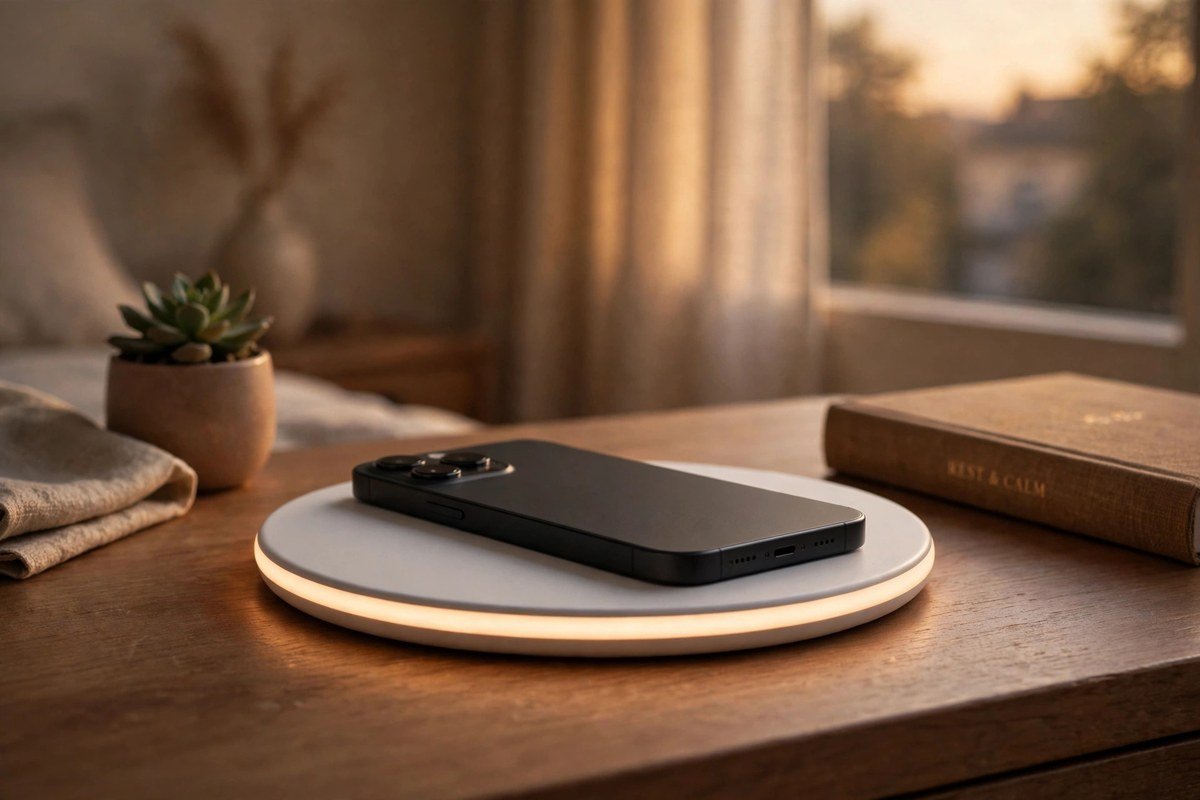
You set your phone down on a pad, no cable in sight, and the battery percentage starts climbing. It feels like magic, but it is not. Wireless charging runs on a physics idea discovered almost 200 years ago, and once you understand it, the quirks of wireless chargers — the slow speeds, the heat, the need to place your phone just right — all start to make sense.
Quick Answer: How Does Wireless Charging Work?
Wireless charging sends power through a magnetic field instead of a cable. Alternating current flows through a transmitter coil inside the charging pad, creating a changing magnetic field. A receiver coil inside your phone picks up that field and turns it back into electric current, which your phone converts into direct current to charge its battery. The whole transfer happens across just a few millimeters, which is why your phone has to sit flat and centered on the pad.
The Simple Science: Electromagnetic Induction
In the 1830s, scientist Michael Faraday discovered that a changing magnetic field can create an electric current in a wire. Wireless charging is that discovery put to everyday use. Here is the chain of events, step by step:
- Power in: The charging pad plugs into the wall and receives electricity.
- Magnetic field out: That electricity is sent as alternating current (AC) through a flat copper coil inside the pad, which creates an oscillating magnetic field just above the pad’s surface.
- Current in your phone: A matching coil inside your phone sits in that magnetic field, and the field induces an alternating current in it.
- Conversion: Your phone’s power management chip converts the alternating current into direct current (DC), the form your battery can store, and regulates the voltage so the battery charges safely.
No metal touches metal. The energy crosses a small air gap carried by the magnetic field alone.
Why Your Phone Needs a Glass or Plastic Back
Metal blocks magnetic fields. That is why phones with wireless charging almost always have glass or plastic backs. A solid metal back would shield the receiver coil and stop charging entirely. It is also why you should take metal objects — coins, cards with magnetic strips, thick metal plates — out from between your phone and the pad. Most modern chargers include foreign object detection: if they sense a stray metal object heating up in the magnetic field, they slow down or stop charging to stay safe.
Qi, Qi2, and Qi2 25W: The Standards Explained
For a charger and a phone from different brands to work together, they need a shared standard. The dominant one is Qi, run by the Wireless Power Consortium. Here is how it has evolved:
- Original Qi: The first widely used version. Phones had to be placed carefully by hand, and typical charging speeds were 5 to 7.5 watts, though the specification allowed up to 15 watts.
- Qi2 (launched November 2023): Added a ring of magnets around the coil — technology that came from Apple’s MagSafe, first seen on the iPhone 12 in 2020. The magnets snap the phone into perfect alignment automatically, which makes charging faster and more consistent, at up to 15 watts.
- Qi2 25W (launched July 2025): The latest version, also called Qi2.2. It keeps the same magnetic alignment but raises the ceiling to 25 watts — nearly 70% more power than the original Qi2. It is backward compatible, so a Qi2 25W charger still charges older Qi and Qi2 phones, just at their own maximum speeds.
The key point: the number on the box is a maximum, not a promise. Your actual charging speed depends on your phone, the charger, the wall adapter, the battery level, and the temperature.
Why Wireless Charging Is Slower Than a Cable
Wireless charging always loses more energy than a wired connection. Some of the magnetic field’s energy never reaches the receiver coil, and the lost energy turns into heat. That is why wireless charging feels slower than plugging in, and why your phone may feel warm on a pad.
Alignment matters a lot. If the coils are even slightly off-center, efficiency drops and charging slows down. Thick cases (generally over 3 millimeters), metal attachments, and pop sockets can also weaken the connection. This is exactly why the magnets in Qi2 were such a big deal: perfect alignment means less wasted energy.
Heat also limits speed on purpose. As a phone warms up, it deliberately slows charging to protect the battery — the same reason charging slows down near 80% on many phones. If you want the fastest wireless charge, keep the phone cool and centered, and use the wall adapter the charger maker recommends.
Why Your Phone Sometimes Won’t Charge Wirelessly
If you put your phone on a pad and nothing happens, run through this checklist:
- Alignment: Re-center the phone on the pad. With non-magnetic chargers, even a small offset can break the connection.
- Case: Remove thick or metal cases and magnetic accessories, then try again.
- Metal objects: Check for coins, keys, or cards between the phone and the pad.
- Power adapter: A weak wall adapter limits the charger. Qi2 25W chargers typically need a USB-C PD adapter rated 30 watts or higher to reach full speed.
- Compatibility: Make sure both the phone and the charger support the same standard. Most modern phones support Qi, but older or budget models may not have wireless charging at all.
Is Wireless Charging Bad for Your Battery?
This is the question most people ask, and the honest answer is: not in any way you need to worry about for normal use. Wireless charging does generate more heat than wired charging, and heat is the main enemy of battery lifespan over years. But phones manage this with temperature limits and charge throttling, and the effect is small compared to other factors like how often you fully drain the battery. If you want to be extra kind to your battery, avoid leaving your phone baking on a warm pad for hours, and take it off the charger once it is full. For a deeper look at what actually wears batteries down, see our guide on why your phone battery drains so fast.
Wireless vs. Wired: Which Should You Use?
Neither is “better” — they suit different moments. Wireless charging wins for convenience: drop the phone on your nightstand or desk and it tops up without fumbling for a cable, and there is no charging port to wear out. Wired charging wins for speed and efficiency, especially when you need a quick top-up before heading out. Many people use both — wireless overnight, where speed does not matter, and a cable during the day when it does. If you want to understand the fast-charging side in more detail, read how fast charging works.
Final Thoughts
Wireless charging is not magic and it is not a gimmick — it is Faraday’s induction principle, refined into a standard that now works across brands. Put a phone on a pad, a magnetic field carries power across a tiny gap, and the phone turns it back into a charged battery. It is slower and warmer than a cable, but for everyday overnight and desk charging, that trade is worth it for most people. And with Qi2 25W closing the speed gap, the cable-free future is only getting closer.





How Does Wireless Charging Work? Explained in Simple Terms
Mesh WiFi vs WiFi Extender: Which Is Better?

15 Best Battery Saving Tips for iPhone and Android (2026)

Empower Your SEO and Design with Seotoolsgroupbuy.us’ Designer Plan

Sejda PDF Editor Review: Features, Pricing & Best Alternatives
