
Tech
7 Best Bluetooth Headphones for Kids in 2026: Safe, Volume-Limited Picks

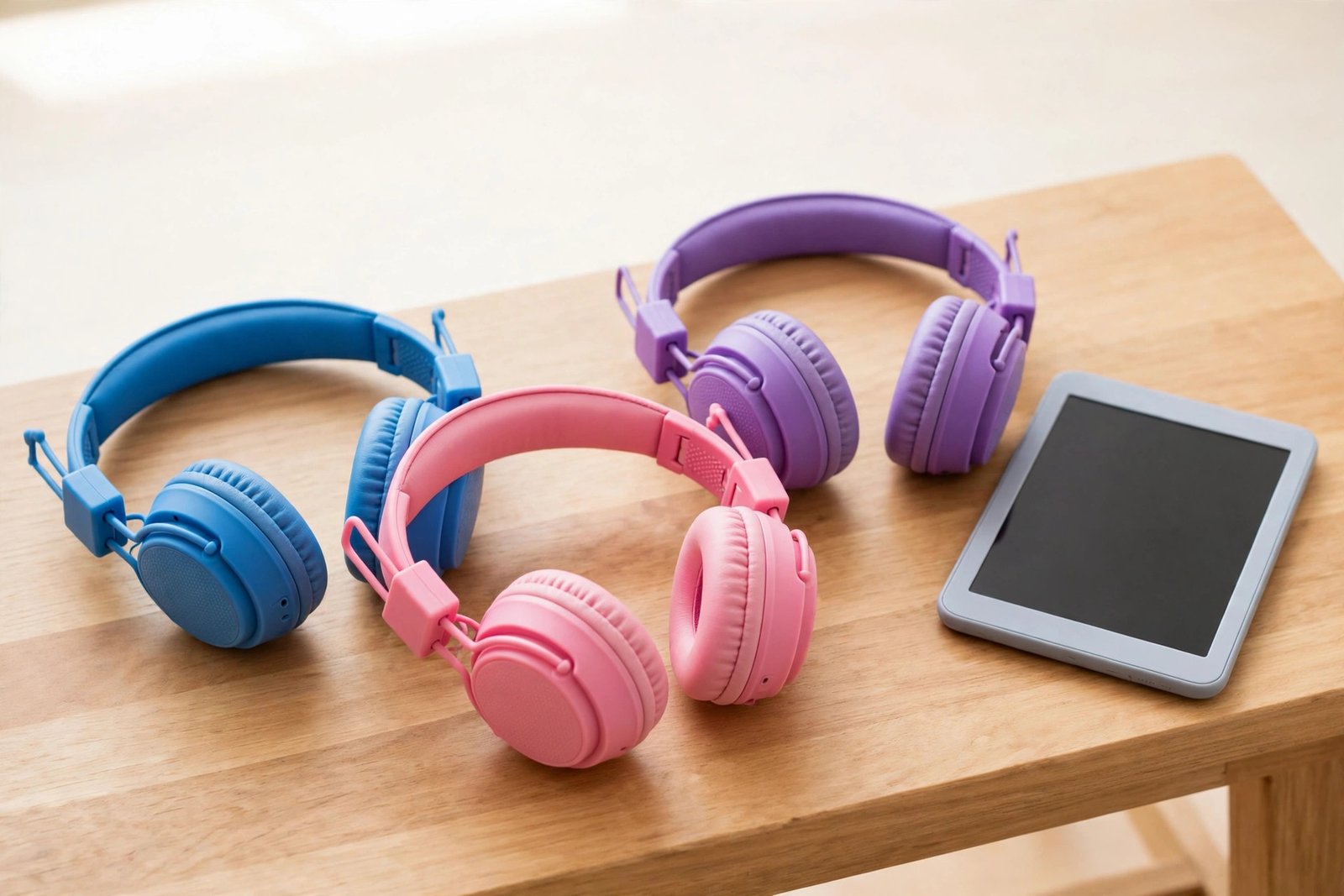
Picking headphones for a child is not the same as picking a pair for yourself. The sound needs to stay at a safe level even when your child turns the volume all the way up, the fit has to suit a smaller head, and the pair has to survive school bags, car rides, and daily use. The seven pairs below all have a built-in volume limit, Bluetooth for tablets and phones, and a wired backup for when the battery runs out. We picked them by comparing manufacturer specs for volume limits and battery life, and by looking at what each pair is actually best for — so you can match the pair to your child’s age and routine, not just to a price tag.
Quick picks
- Best overall: JBL Junior 320BT — simple parental controls and 50 hours of battery.
- Best for noisy places: JBL Junior 470NC — adds active noise cancelling to the same safe-volume idea.
- Best sound quality: Puro Sound Labs BT2200 Plus — studio-style sound with a manufacturer-stated 85dB cap.
- Best for older kids: JLab JBuddies Pro Wireless — made for ages 8 and up, with a share mode for two listeners.
- Best battery life: iClever BTH12 — up to 85 hours with the lights off.
- Best fun design: iClever BTH13 Cat Ear — light-up cat ears kids actually want to wear.
- Best for the youngest kids: BuddyPhones Play+ — a 75dB toddler mode for the smallest listeners.
1. JBL Junior 320BT — Best overall
The Junior 320BT is the easiest recommendation on this list. JBL’s Safe Sound design means the headphones are made to never go past 85dB, and the JBL Headphones app lets parents set an even lower maximum, limit daily listening time, and check daily and weekly usage reports behind a PIN. Battery life is rated at up to 50 hours, a five-minute charge gives about three more hours, and a built-in mic covers online lessons and calls with family. It is an on-ear pair, so it is lighter and less bulky than over-ear models — a good fit for school and travel.
Best for: most kids, especially if you want parental controls without paying for noise cancelling.
2. JBL Junior 470NC — Best for noisy places
The 470NC takes the same idea as the 320BT and adds active noise cancelling, which shuts out background noise so your child does not feel the need to turn the volume up on a plane, a bus, or in a busy classroom. The volume still stays under 85dB, and the app offers the same parental controls for maximum volume and listening time. Battery life is up to 50 hours with noise cancelling off and 28 hours with it on, so it is worth switching ANC off at home to stretch the charge.
Best for: travel and noisy environments, and older kids who want over-ear comfort.
3. Puro Sound Labs BT2200 Plus — Best sound quality
Puro built the BT2200 Plus around one promise: sound capped at 85dB by the manufacturer, with a clearer, more detailed sound than most kids’ headphones manage. It works over Bluetooth and with a cable, and the ear cups can be swapped for a fresh look. One honest note: the volume-limiting cable that comes in the box matters in wired mode, so keep it with the headphones rather than swapping in any old cable. If sound quality is your top priority and your child will mostly listen over Bluetooth, this is the pair to shortlist.
Best for: music-loving kids whose parents care as much about sound as about the volume cap.
4. JLab JBuddies Pro Wireless — Best for older kids
Made for ages 8 and up, the JBuddies Pro is a wireless over-ear pair with more than 35 hours of Bluetooth playtime, soft cloud-foam cushions, and a mic for calls and class. The hearing-protection switch sits hidden inside the earcup so only a parent can change it: it stops sound at 85dB on the recommended setting, with a 95dB option for louder surroundings that is best left alone for everyday listening. The included AUX cable adds a wired mode and a share mode, so two kids can watch one movie together.
Best for: school-age kids and teens who need a sturdy everyday pair for homework and travel.
5. iClever BTH12 — Best battery life
If charging is the thing you always forget, the BTH12 is hard to beat: up to 85 hours of playtime on a full charge with the LED lights off, and a 10-minute USB-C charge gives about 7 more hours. The volume can be set to 74dBA for quiet rooms or 85dBA for noisier places, switched with a button combination so it cannot be changed by accident. It connects over Bluetooth 5.2, folds down for a bag, and comes with a 3.5mm cable for wired listening when the battery finally runs out.
Best for: long trips, busy school weeks, and families who do not want another device to charge every night.
6. iClever BTH13 Cat Ear — Best fun design
The BTH13 is the pair kids pick for themselves: cat ears with RGB lights, an adjustable headband, and soft ear pads, sized for ages 3 to 16. Under the fun design it is a serious kids’ pair, with the same 74dBA study mode and 85dBA travel mode as the BTH12, switched by pressing the volume buttons together. Battery life is up to 50 hours with the lights off, and the wired cable keeps it going when the battery is flat. Turning the lights off is the simplest way to stretch the battery on a long day out.
Best for: younger kids who will only wear headphones they like the look of.
7. BuddyPhones Play+ — Best for the youngest kids
The Play+ is the only pair here with a mode made for toddlers: Toddler Mode caps volume at 75dB, Kids Mode at 85dB, and Travel Mode at 94dB for noisy places like planes. A Study Mode setting also sharpens voices for lessons and audiobooks. Battery life is up to 20 hours over Bluetooth, with a wired cable in the box for when it runs out, plus a sharing cable so a sibling can listen in. The shorter battery life is the trade-off for the toddler-friendly design and the three volume modes.
Best for: toddlers and preschoolers, and families sharing one pair between a younger and an older child.
How to choose Bluetooth headphones for kids
Start with the volume limit, not the brand. Look for a stated cap of 85dB or lower, and check whether it applies in both Bluetooth and wired mode. On several pairs here the limit is a setting, not a fixed ceiling — set it to the lower option for everyday listening and keep the higher setting for planes and busy streets only.
Match the fit to the age. On-ear pairs are lighter and pack smaller; over-ear pairs seal out more noise and usually feel better for longer listening. Check the maker’s age guidance — the JLab pair is aimed at ages 8 and up, while the iClever cat-ear pair and the BuddyPhones Play+ suit younger children.
Check the battery against real life. Manufacturer hours are best-case figures, usually with lights and noise cancelling off. A pair rated at 50 hours will still comfortably cover a school week; a 20-hour pair needs a regular charging habit, so the wired cable matters more.
Keep a wired backup. Every pair on this list includes a cable. That matters on planes, at school, and on any device that does not allow Bluetooth — and it means a dead battery never ends the movie.
Skip adult headphones and earbuds for small children. Adult pairs have no volume cap and are sized for adult heads, which leaves gaps that let noise in and tempt kids to turn the volume up. Small in-ear buds are also easy to lose and hard to fit safely in young ears.
What to avoid
- Headphones with no stated volume limit — “kid-friendly” on the box is not the same as a decibel cap.
- Pairs where the limit only works in one mode. If the wired cable bypasses the limiter, use only the cable that came in the box.
- Leaving a higher-volume mode switched on for everyday use. The 94dB and 95dB settings on some pairs are for noisy travel, not daily listening.
- Buying on looks alone. A fun design helps a child actually wear the pair, but the limit, fit, and battery decide whether it is a good buy.
Frequently asked questions
Are Bluetooth headphones safe for kids?
Bluetooth headphones made for kids are designed around a volume cap — usually 85dB or lower — rather than around adult listening levels. The cap is the key safety feature, so check the stated limit and the mode it is set to before you hand the pair over.
What does 85dB mean?
Decibels measure how loud sound is. 85dB is the level many hearing-health guides treat as the upper end of safe daily listening for children, which is why so many kids’ pairs cap out there. Quieter settings like 74dB or 75dB are better for long, quiet-room listening.
Do volume-limited headphones work with iPads and school tablets?
Yes. All seven pairs here connect over standard Bluetooth, so they pair with iPads, Android tablets, Chromebooks, phones, and laptops. If a school device blocks Bluetooth, the included wired cable covers that case too.
Can two kids share one pair?
Not one pair between two heads, but the JLab JBuddies Pro and the BuddyPhones Play+ both include a sharing cable or mode so two children can listen to the same device at once — handy for movies on a flight.
How do I pair kids’ Bluetooth headphones?
Put the headphones in pairing mode (usually by holding the power button), open Bluetooth settings on the tablet or phone, and pick the headphones from the list. If a pair keeps dropping the connection, move the device closer, charge the headphones, and forget and re-pair them — the same basic fix works for most Bluetooth pairs. If you want the full walkthrough, see our guide on how to connect Bluetooth headphones to any device, and if dropouts keep happening, our guide to why Bluetooth headphones keep disconnecting covers the common causes.
The bottom line
For most families, the JBL Junior 320BT is the safest all-round buy: a real volume cap, parental controls you can actually lock, and battery life that covers a school week. If your child travels a lot, step up to the noise-cancelling JBL Junior 470NC; if battery life is the pain point, the iClever BTH12 wins; and for the youngest listeners, the BuddyPhones Play+ with its 75dB toddler mode is the careful choice. Whichever pair you pick, set the lowest volume mode that works, keep the included cable in the bag, and check the setting now and then — the limit only protects young ears if it stays switched on.

7 Best Bluetooth Headphones for Kids in 2026: Safe, Volume-Limited Picks

Why Do Bluetooth Headphones Keep Disconnecting? Causes and Fixes

How to Connect Bluetooth Headphones to Any Device: A Simple Guide

Empower Your SEO and Design with Seotoolsgroupbuy.us’ Designer Plan

Twstalker Twitter Web Viewer: Guide to Anonymous Twitter Browsing
