
Tech
How Does Fast Charging Work? Explained in Simple Terms

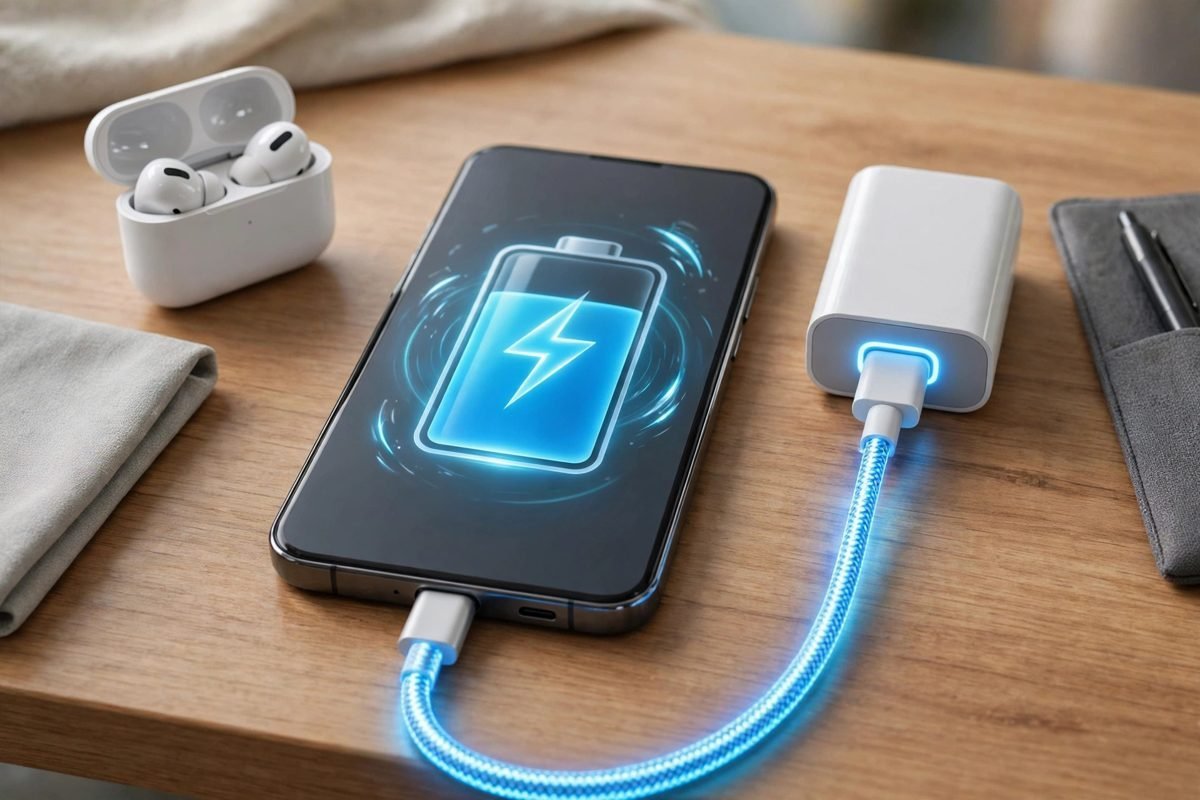
You plug in your phone at 10 percent, make a coffee, and ten minutes later it is already past 50 percent. A few years ago that same charge would have taken over an hour. So what changed? The short answer is that fast charging pushes more electrical power into your phone, and your phone and charger work together to do it safely. Here is how it actually works, in plain terms.
First, what is fast charging?
Any phone that charges at a higher rate than the old basic standard counts as fast charging. The old standard USB chargers delivered about 5 watts, and later 10 watts. Most phones today accept 15 watts or more, and many go far beyond that — 25, 45, 65 watts, and some Android phones even pass 100 watts. The higher the wattage, the faster the battery fills, at least in theory.
But wattage alone does not tell the whole story. A 120-watt charger will not charge a phone that only supports 30 watts any faster than a 30-watt charger would. Your phone is always in charge of the speed, not the brick on the wall.
How charging power works: watts, volts, and amps
Charging power is measured in watts, and watts come from a simple formula: watts = volts × amps. Volts are the “pressure” pushing electricity along, and amps are the amount of electricity flowing. To deliver more power, a fast charger raises one or both of these numbers.
A basic old charger delivered 5 volts at 1 amp, which is 5 watts. A modern fast charger might deliver 9 volts at 3 amps, which is 27 watts — more than five times as much power. That is the whole trick at its core: more power in, faster fill-up.
The handshake: your phone and charger talk first
Nothing happens the moment you plug in until your phone and charger agree on a safe power level. This is called the handshake. The charger tells the phone what voltages and currents it can deliver, and the phone replies with what it can safely accept. They settle on the highest level both support.
This is why the cable matters too. A cheap or damaged cable can fail the handshake or limit the power, and your phone quietly falls back to slow charging. If your phone suddenly charges slowly, the cable is one of the first things worth swapping.
Why charging slows down near the end
If you have ever noticed that the last 20 percent takes much longer than the first 50 percent, that is not a fault — it is by design. A lithium-ion battery, the type in every modern phone, charges in stages:
- Fast stage (roughly 0 to 50 percent): the battery is nearly empty, so it can safely take a lot of power. This is where the big speed gains happen.
- Slowing stage (roughly 50 to 80 percent): as the battery fills, the voltage approaches its safe limit, so the phone reduces the current to protect the battery.
- Topping stage (80 to 100 percent): the phone trickles in the last bit of charge gently. This is why going from 80 to 100 percent can feel slower than going from 0 to 50 percent.
Phone makers advertise the fast part — “50 percent in 30 minutes” — because that is the part that feels impressive. The full charge always takes longer.
The charging standards behind it
Not all fast charging is the same. There are open standards any brand can use, and proprietary systems built by individual companies.
USB Power Delivery (USB PD)
USB Power Delivery is the open standard used by iPhones, Pixels, Samsung phones, and most laptops. A USB PD charger and a phone negotiate voltage levels like 5V, 9V, 15V, and 20V, and the standard now supports up to 240 watts for bigger devices like laptops. For phones, the practical range is usually 18 to 45 watts.
USB PD PPS
PPS (Programmable Power Supply) is an extension of USB PD that adjusts voltage in tiny steps instead of fixed levels. This finer control means less energy wasted as heat, which is why Samsung’s Super Fast Charging and many Google Pixel chargers rely on PPS.
Brand systems: Quick Charge, SuperVOOC, and others
Qualcomm’s Quick Charge is common on Android phones with Snapdragon chips. OnePlus and Oppo use SuperVOOC, which pushes very high current instead of high voltage and can fill a phone in under 30 minutes. These proprietary systems are often the fastest of all, but they usually need the brand’s own charger and cable to reach top speed.
Does fast charging damage your battery?
This is the question everyone asks, and the honest answer is: a little, but far less than people fear. Heat is what wears a battery out, and fast charging creates more heat than slow charging. But modern phones manage this aggressively — they slow down when they get warm, they cap the charge at 80 percent overnight on some models, and they stop charging entirely once full.
In practice, the difference in battery lifespan between fast and slow charging is small for most people, because you replace the phone long before the battery wears out either way. What hurts a battery more is constant heat — like leaving a phone charging in a hot car — or keeping it at 100 percent for weeks on end.
If you want your battery to last as long as possible, our guide on why your phone battery drains so fast — and how to fix it covers the habits that actually make a difference.
How to actually get fast charging on your phone
- Check your phone’s maximum wattage. If your phone supports 25 watts, a 25-watt charger is all you need. A bigger charger will not speed it up.
- Use the right charger and cable. For iPhones and Pixels, a USB-C PD charger works best. For Samsung, look for a PPS-compatible charger. For OnePlus or Oppo, the charger in the box is usually required for full speed.
- Check the cable rating. Some USB-C cables only carry low power. If fast charging is not kicking in, try the cable that came with the phone.
- Keep the phone cool while charging. Take it out of a thick case and out of direct sunlight if it feels warm.
- Do not worry about overnight charging. Modern phones stop at full and manage the trickle, so an overnight charge is fine.
Why is my phone charging slowly all of a sudden?
Most of the time, the cause is simple. The charger or cable is not fast-charge capable, the phone is hot and protecting itself, or you are using the phone heavily while it charges — gaming or video calls while plugged in can eat power almost as fast as the charger supplies it. A dirty charging port can also break the connection; a gentle clean with a wooden toothpick often fixes it.
The bottom line
Fast charging works by pushing more watts into your phone through a negotiated handshake between charger and phone, then easing off as the battery fills to protect it. The number on the charger box is only a maximum — your phone decides how much of it to actually use. Match the charger to your phone, use a good cable, and you will get the fastest charge your phone is built for.


How Does Fast Charging Work? Explained in Simple Terms
Duolingo vs Babbel: Which Language App Is Better in 2026?

70+ Funny WiFi Names That Will Make Your Neighbors Laugh (2026)

Empower Your SEO and Design with Seotoolsgroupbuy.us’ Designer Plan

Sejda PDF Editor Review: Features, Pricing & Best Alternatives
